Thailand Retirement Visa: ฿800,000 Rules, Traps & Insurance Costs
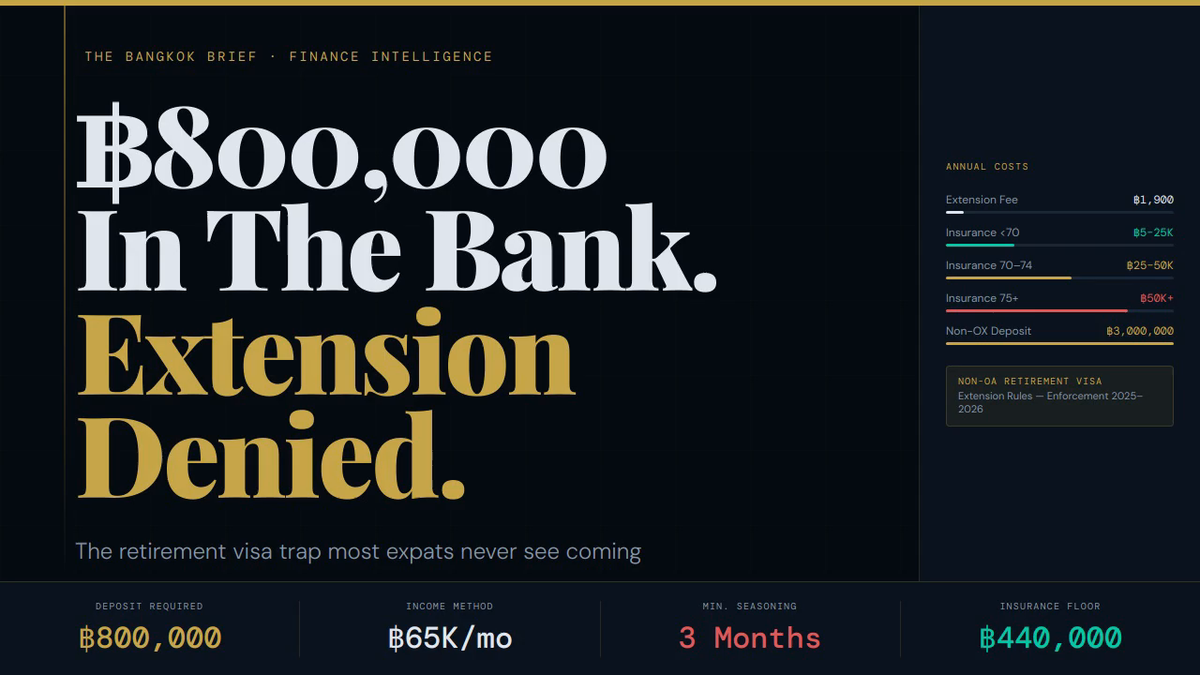
The Thailand retirement visa extension is denied to thousands of expats every year — not because they lack the money, but because they didn't know a rule that isn't written on the immigration website. If you are planning to retire in Thailand or currently hold a Non-OA or Non-OX visa, the financial requirements in 2026 are more complex, more locally variable, and more unforgiving than any official summary suggests. This article gives you every number, every deadline, and every trap in one place.
Non-OA vs Non-OX: Which Retirement Visa Are You Actually On?
Most long-stay retirees in Thailand hold a Non-Immigrant OA visa (Non-OA). It is available at Thai consulates and embassies abroad, requires proof of age 50+, a clean criminal record, and a health certificate. It is valid for one year and must be extended annually at your local Immigration office in Thailand.
The Non-Immigrant OX visa is less well known. It requires a ฿3,000,000 Thai bank deposit — not ฿800,000 — and is only available from the Royal Thai Consulate in select countries. In return, it offers a longer initial validity period. The vast majority of retirees do not qualify or cannot access it from their country of residence. Unless you specifically meet the OX criteria, assume you are on the Non-OA path.
The 3 Financial Methods to Qualify for Extension
Thai Immigration offers three routes to prove financial eligibility for a Non-OA annual extension. In practice, only two are widely accessible in 2026:
Method 1: ฿800,000 Thai Bank Deposit
You must hold ฿800,000 in a Thai bank account, in your name, in baht. The account must be at a Thai bank — not a foreign account, not a multi-currency account, not a wire transfer en route. Bangkok Bank, Kasikorn Bank, and SCB are most commonly used by expats. The money must be seasoned — in place for a defined period before your extension date (see the Seasoning Trap section below). Around the extension date it cannot drop below ฿800,000. Between annual renewals, the balance must not fall below ฿400,000 at any point.
Method 2: ฿65,000/Month Income
You must demonstrate a regular monthly income of at least ฿65,000 (approximately USD 1,800 / GBP 1,400 at 2026 exchange rates). This was historically proven by an income affidavit from your home country's embassy in Bangkok. That route has closed for many nationalities:
- British Embassy Bangkok stopped issuing income affidavits in February 2019.
- US Embassy Bangkok stopped issuing income affidavits in February 2019.
- Several other Western embassies have followed. Check with your specific embassy before relying on this method.
If your embassy no longer issues affidavits, you must use bank statements and supporting documentation — which Immigration officers may or may not accept at their discretion. This method has become unreliable for UK and US nationals specifically.
Method 3: Combination
If your monthly income falls short of ฿65,000, you can combine verified income with a Thai bank deposit, with the total required to reach ฿800,000. For example: if you receive ฿40,000/month in pension income (฿480,000 annually), you would need a Thai bank deposit of at least ฿320,000 to make up the shortfall. This method requires documentation of both elements and is subject to individual officer discretion.
The Seasoning Trap: The Rule That Isn't on the Website
This is the single most common reason compliant retirees have their extensions denied.
The official Thai Immigration rule states the ฿800,000 must be in the account for at least 2 months before the extension application. Many expats follow this exactly and are denied. Why?
Local immigration offices set their own additional requirements. Chiang Mai Immigration — one of the busiest retirement visa offices in the country — enforces a 3-month seasoning requirement. This is not published on the central Immigration Bureau website. It is communicated verbally at the counter or through local expat networks. Pattaya, Hua Hin, and other regional offices have been reported to apply similar local interpretations.
The practical rule: season your ฿800,000 for a minimum of 3 months before your extension date, regardless of what the official guidance states. Contact your specific local Immigration office to confirm their current interpretation. Do not rely on what worked for someone else at a different office.
Mandatory Health Insurance: The Requirements in 2026
Since 31 October 2019, health insurance is compulsory for all Non-OA retirement visa extensions. A missing or non-compliant insurance document will end your extension application before the financial check even begins.
The minimum required coverage is:
- Outpatient (OPD): ฿40,000 per year
- Inpatient (IPD): ฿400,000 per year
The policy must be from a Thai-licensed insurer or an internationally recognised insurer approved by the Office of Insurance Commission (OIC). A foreign policy is not automatically accepted. Check the OIC-approved insurer list before purchasing.
2026 Health Insurance Premium Benchmarks
| Age Band | Annual Premium Range (Healthy, Non-Smoker) | Notes |
|---|---|---|
| Under 70 | ฿5,000 – ฿25,000 | Widest choice of insurers; entry-level OIC-approved plans available |
| Age 70–74 | ฿15,000 – ฿55,000 | Some insurers exit at 70; fewer options, higher loading |
| Age 75+ | ฿25,000 – ฿80,000+ | Pre-existing conditions may render standard plans unavailable |
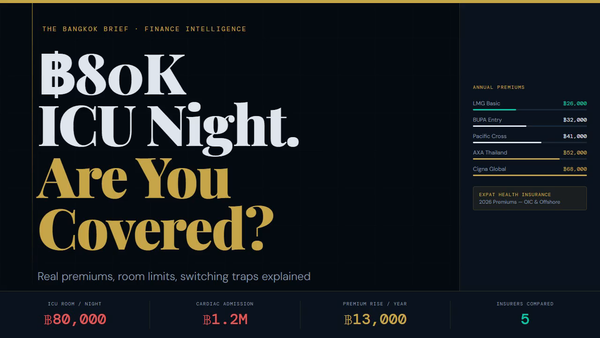
These are benchmarks for minimum-compliant plans — not comprehensive private health cover. If you want genuine protection at Thai private hospitals (where a single ICU night at Bumrungrad runs ฿25,000–฿80,000 room charge alone), budget significantly more. The visa-compliant minimum and sensible medical cover are not the same number.
Annual Cost of Holding a Thailand Retirement Visa
| Cost Item | Amount (2026) | Frequency |
|---|---|---|
| Visa extension fee | ฿1,900 | Annual |
| Health insurance (under 70, minimum compliant) | ฿5,000 – ฿25,000 | Annual |
| Health insurance (age 70–74) | ฿15,000 – ฿55,000 | Annual |
| Health insurance (age 75+) | ฿25,000 – ฿80,000+ | Annual |
| TM.30 notification (if applicable) | ฿0 (online) / ฿800 (late fine) | Per change of address |
| 90-day reporting | ฿0 (online or in-person) | Every 90 days |
| Re-entry permit (if leaving Thailand) | ฿1,000 (single) / ฿3,800 (multiple) | Per trip (without = visa cancelled) |
Note on re-entry permits: If you leave Thailand without a re-entry permit, your Non-OA extension is cancelled the moment you cross the border. You will need to obtain a new Non-OA from a Thai consulate abroad. This is one of the most expensive and avoidable mistakes long-stay retirees make.
Worked Example: ฿800,000 Deposit Method — Exactly What You Need
Suppose you are a 68-year-old British national living in Chiang Mai, retiring on a UK state pension of approximately ฿32,000/month (around GBP 700/month at mid-2026 rates). Your embassy no longer issues income affidavits. Here is exactly what you need to do:
- Open a Thai bank account in your name at Bangkok Bank or Kasikorn Bank. Bring your passport, Non-OA visa, and proof of address.
- Deposit ฿800,000 at least 3 months before your extension date (Chiang Mai rule; confirm with your local office).
- Do not let the balance fall below ฿800,000 during the seasoning window. Set up account alerts.
- Obtain a bank letter from your Thai bank confirming the balance — this is a formal letter issued by the branch, not a printout. Allow 1–2 business days. Cost: approximately ฿200.
- Purchase OIC-approved health insurance with at least ฿40,000 OPD / ฿400,000 IPD. At age 68, budget ฿15,000–฿40,000/year depending on insurer and health history.
- On extension day, bring: passport, current Non-OA visa, bank letter, bank passbook (updated to the day), health insurance certificate, TM.7 form, one passport photo, and copy of every relevant passport page. Some Chiang Mai officers also request a copy of your house registration (Tabien Baan) or lease agreement.
Total capital immobilised: ฿800,000 (not spent, but not accessible without restarting the seasoning clock).
Annual cash cost: ฿1,900 (extension) + ฿25,000 (insurance estimate) = approximately ฿26,900/year in direct visa costs, excluding re-entry permits.
Between renewals: Balance must not drop below ฿400,000 at any time. If it does, you must rebuild to ฿800,000 and re-season — the full 2–3 month window restarts.
The Non-OX Visa: Is ฿3,000,000 Worth It?
The Non-OX visa requires a ฿3,000,000 deposit held in a Thai bank. In exchange, it typically offers a longer initial stay period than the Non-OA and may reduce annual extension paperwork in early years. However:
- It is only available at select Royal Thai Consulates abroad — not at all Thai embassies.
- The ฿3,000,000 is similarly subject to seasoning and minimum balance rules.
- At 2026 interest rates, ฿3,000,000 in a Thai savings account earns approximately ฿45,000–฿60,000/year (1.5–2% p.a.) — a meaningful opportunity cost if you could deploy that capital elsewhere.
- For most retirees on standard pension income, the Non-OX deposit requirement is prohibitive. The Non-OA ฿800,000 route is the realistic path.
Thailand Macro Context: Is the Retirement Visa Still Good Value in 2026?
Thailand's GDP growth in 2024 was 2.54%. Inflation in 2024 was 1.37% — among the lowest in Southeast Asia. The cost of living in Chiang Mai and secondary cities remains substantially below Bangkok, and well below comparable retirement destinations in Europe or North America. The fundamental financial case for retiring in Thailand has not changed materially. The regulatory complexity has increased, but for those who know every rule before it matters, the visa remains highly accessible.
Frequently Asked Questions
Can I use a foreign bank account to meet the ฿800,000 requirement?
No. The ฿800,000 must be held in a Thai bank account in your name, denominated in Thai baht. A foreign account balance, even if equivalent in value, is not accepted by Immigration for the deposit method. You must transfer the funds to Thailand and hold them in a qualifying Thai bank account.
What happens if my balance drops below ฿400,000 between renewals?
If your balance falls below ฿400,000 at any point in the period between annual extensions, you are technically in breach of the condition. When you next apply for an extension, Immigration may require you to have seasoned the full ฿800,000 again. In practice, enforcement varies by office, but the risk is real — particularly in offices with stricter local practices like Chiang Mai.
My embassy no longer issues income affidavits. What are my options?
If you are British, American, or from another country whose embassy has ceased issuing income letters, you have two practical options: (1) use the ฿800,000 deposit method in full, or (2) use the combination method if you can document regular income via bank statements and have a partial Thai bank deposit to cover the shortfall. Some expats use a Thai accountant or agent to compile supporting documentation, but the deposit method is the most reliable and least discretionary route in 2026.
Does my health insurance need to be purchased from a Thai company?
It must be from an insurer licensed by Thailand's Office of Insurance Commission (OIC) or an internationally recognised insurer on the OIC approved list. Some international policies (such as certain AXA, BUPA, or Cigna international plans) are OIC-recognised. Check the current OIC list before purchase — the list changes, and a policy that was accepted last year may not appear on the current approved list.
If I leave Thailand for a holiday, does my Non-OA extension get cancelled?
Yes — unless you purchase a re-entry permit before you leave. A single re-entry permit costs ฿1,000; a multiple re-entry permit costs ฿3,800. Both are purchased at your local Immigration office or at the airport (though airport purchase is riskier for timing). If you exit without a re-entry permit, your extension is voided on departure, and you must obtain a new Non-OA visa from a Thai consulate abroad before returning.
Action Steps Before Your Next Extension
- Confirm your local Immigration office's seasoning requirement — call or visit to ask whether they enforce 2 months or 3 months. Do not assume the national rule applies locally.
- Check your Thai bank balance today. If you are within 4 months of your extension date and the balance is below ฿800,000, deposit the full amount immediately and start the seasoning clock.
- Verify your health insurance is OIC-compliant for the current year. Check the OIC website (oic.or.th) for the current approved insurer list. Confirm your policy covers at least ฿40,000 OPD and ฿400,000 IPD.
- Check whether your embassy still issues income affidavits if you intend to use the income method. If not, pivot to the deposit method now — do not wait until extension week.
- Buy a re-entry permit before any international travel. A ฿3,800 multiple re-entry permit is one of the cheapest insurance purchases you will ever make against a very expensive mistake.
- Prepare a full document checklist specific to your Immigration office — passport copies, bank letter (not older than 7 days at many offices), updated passbook, TM.7 form, insurance certificate, photos, and lease or address proof.