Thailand Border Run Ban: What Every Expat Must Do Now
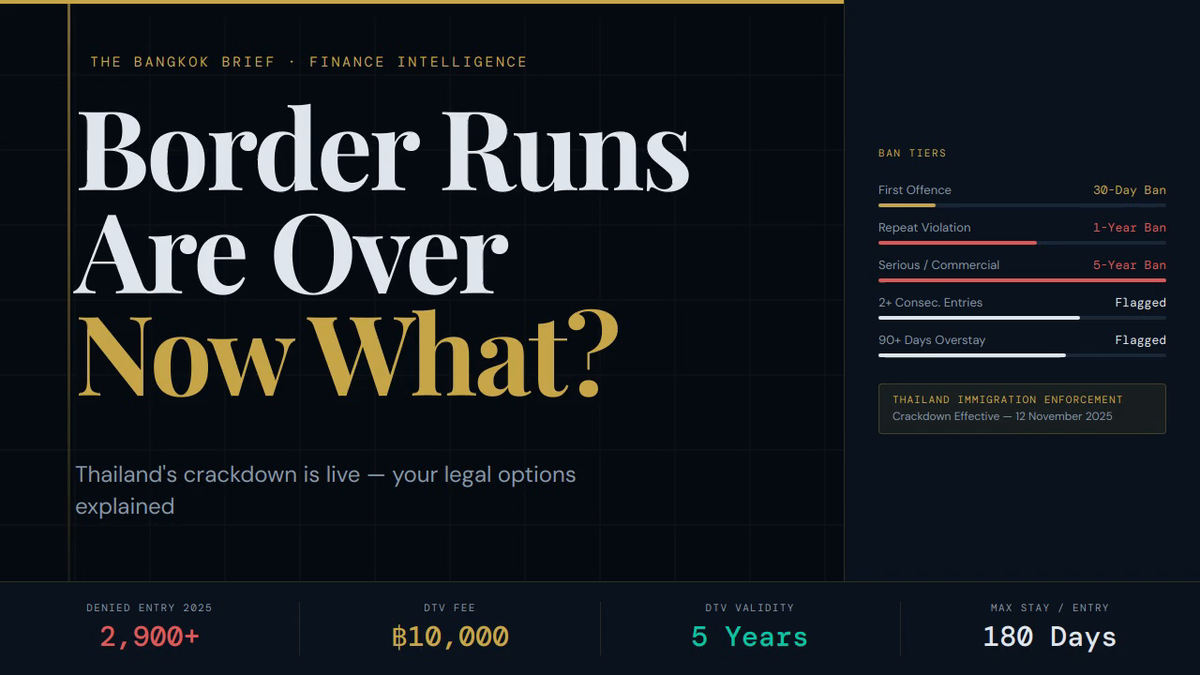
As of 12 November 2025, Thailand's border-run era is over — not because the law changed, but because enforcement finally did. A centralised algorithmic immigration database now flags passports automatically, and the consequences are immediate: bans ranging from 30 days to 5 years, issued at the border, with no appeals process and no refunds on travel costs. Over 2,900 foreigners were already denied entry in the first months of 2025 alone. If you are living in Thailand on rolling tourist visas or land-border entries, this is the most urgent immigration development in a decade.
What Actually Changed on 12 November 2025
The legal framework that makes border runs problematic has existed since 2014. Royal Thai Police Order 327/2557 established that entry into Thailand requires a genuine purpose — tourism, business, transit — not simply the mechanical act of crossing a border to reset a stamp. For years, enforcement was discretionary and inconsistent. Individual officers could wave people through, and most did.
That discretion is gone. Following an urgent high-level meeting of Thai Immigration Command in late 2025, a directive was issued activating centralised algorithmic screening across all land border checkpoints. The system does not involve human judgment at the point of decision. It reads your passport history, applies set trigger criteria, and either clears you or flags you — before you even speak to an officer.
How the Flagging System Works
The new database is a cross-border passport tracking system that aggregates entry and exit data across all Thai land crossings. The algorithm flags passports based on patterns that indicate "visa tourism" rather than genuine travel. Two confirmed trigger criteria are:
- 2 or more consecutive land-border entries within a 12-month period — flagged for review
- 90 or more cumulative days on tourist-entry stamps within a rolling period — flagged for review
Being flagged does not automatically mean denial, but it triggers enhanced scrutiny. In practice, given the November 2025 directive, flagged passports are being denied at a rate consistent with the 2,900+ figure already recorded. There is no on-the-spot appeal. The decision is logged centrally, the ban is issued, and the traveller is turned around at the border.
The Ban Tier Structure
| Offence Level | Ban Duration | Appeals Process | Notes |
|---|---|---|---|
| First offence (pattern flagged) | 30-day ban | None | Logged in central database |
| Repeat violation | 1-year ban | None | Second flag on same passport |
| Serious / commercial visa abuse | Up to 5-year ban | None | Includes organised "visa run" services |
The absence of any appeals process is the most significant operational detail here. If you are denied, you cannot argue your case, present evidence of legitimate intent, or speak to a supervisor. The record is set. Your only recourse is to wait out the ban period and then apply for a proper long-stay visa before attempting re-entry.
Why the Border Run "Worked" Until Now
To understand why so many expats are caught off guard, it helps to understand the old enforcement environment. Thai immigration officers at land crossings have historically had wide personal discretion. The law was clear — entries required genuine purpose — but applying it required effort, created queues, and sometimes involved awkward conversations the officers preferred to avoid. The result was a de facto tolerance of border runs that lasted for decades and spawned an entire ecosystem of minibus services, guesthouses, and even packaged "visa run" tourism.
The November 2025 crackdown removes that officer-level discretion by making the algorithmic flag the operative decision. An officer who might personally have been happy to stamp your passport cannot override a system-level denial. This is the structural shift that makes the current situation categorically different from any previous "crackdowns" that were announced and then quietly abandoned.
The DTV Visa: The Clearest Alternative
For digital nomads, remote workers, and long-stay expats who do not qualify for retirement or marriage visas, the Destination Thailand Visa (DTV) is now the most practical long-stay solution available. Key parameters:
| Parameter | DTV | Repeated Border Runs (old approach) |
|---|---|---|
| Upfront cost | ฿10,000 (~$275 USD) | ~$120 per run (transport + accommodation) |
| Validity | 5 years | 30–60 days per entry |
| Days per entry | 180 days (extendable once in-country) | 30–60 days |
| Entries | Multiple (unlimited) | Single land entry per run |
| Legal status | Fully compliant | High-risk under current enforcement |
| Annual amortised cost (USD) | ~$55/year | ~$480/year (4 runs) |
The DTV was introduced in part as a response to the informal long-stay economy that border runs represented. Thai authorities are, in effect, offering a legal and cheap alternative at the same time as closing off the illegal one.
Worked Example: The Cost of Staying on Border Runs vs. Switching to DTV
Consider a digital nomad — let's call him Marco — who has been living in Chiang Mai for three years on rolling tourist visas, doing a land border run to Myanmar every 60 days. His annual run schedule looks like this:
- 6 border runs per year (every ~60 days)
- Each run: minibus to Mae Sai ~฿800 return + one night accommodation ฿600 + food and incidentals ฿400 = ฿1,800 per run
- Annual border-run cost: 6 × ฿1,800 = ฿10,800/year (~$300 USD)
- Time cost: approximately 1.5 days per run × 6 = 9 days per year lost to travel
Under the new enforcement regime, Marco's passport is algorithmically flagged after his second consecutive land entry. On his third run, he is denied at Mae Sai, issued a 30-day ban, and must return to Chiang Mai immediately. He now has 30 days to either leave Thailand entirely or urgently apply for a different visa from abroad — at significant extra cost and disruption.
Had Marco applied for a DTV before the crackdown:
- One-time fee: ฿10,000 (~$275 USD)
- Validity: 5 years
- Amortised annual cost: ฿2,000/year (~$55 USD)
- Per-entry stay: 180 days — meaning Marco only needs to leave Thailand once per year to trigger a new 180-day entry, and can do so by air to any destination
- Net saving over 5 years vs. border runs: approximately ฿44,000 (~$1,220 USD) plus 45 days of recovered time
The DTV is not just legally safer — it is materially cheaper over any multi-year horizon.
DTV Application: What You Need
The DTV must be applied for at a Thai embassy or consulate abroad — it cannot be obtained inside Thailand. Key requirements include:
- Valid passport (minimum 18 months remaining validity recommended)
- Proof of funds: typically bank statements showing sufficient financial means (specific thresholds vary by consulate — confirm with your nearest Thai embassy)
- Evidence of remote work, freelance income, or other qualifying activity
- Application fee: ฿10,000 (approximately $275 USD at current rates)
- Completed application form and passport photographs
Processing times vary by consulate, typically ranging from same-day to 5 business days. Many expats currently in Thailand on tourist stamps will need to make a planned exit — ideally by air to a neighbouring country — to apply. This is a one-time inconvenience that buys five years of legal clarity.
Who Is Most at Risk Right Now
Not every expat faces the same level of urgency. The risk profile breaks down as follows:
- Highest risk: Anyone who has made 2+ land-border entries in the past 12 months and is planning another. The algorithm has almost certainly already flagged your passport.
- High risk: Anyone who has spent 90+ cumulative days in Thailand on tourist entries in the past year without a long-stay visa.
- Moderate risk: Anyone on a series of tourist visa entries obtained from Thai embassies abroad (as opposed to visa-exempt entries), particularly if the pattern is repetitive.
- Lower risk: Those on valid Non-Immigrant visas (O, B, ED), retirement extensions, marriage extensions, or the DTV itself. These are not affected by the crackdown.
Frequently Asked Questions
Can I just fly out and back instead of doing a land border run?
Air entries are treated differently by the algorithm — they are less likely to trigger the "consecutive land entry" flag. However, the 90-day cumulative tourist-stamp rule applies regardless of how you enter. Repeatedly flying in and out on 30-day exemptions will still create a pattern that risks flagging over time. The DTV remains the correct long-term solution; air-based re-entries are not a reliable workaround.
I'm already inside Thailand on a tourist stamp. What should I do right now?
If your stamp is still valid, you have time to plan properly. Do not attempt a land border run as your exit strategy. Instead: (1) check how many land entries appear in your passport over the last 12 months, (2) if you have 2+, plan to exit by air to a country with a Thai consulate, (3) apply for the DTV before re-entering, and (4) re-enter Thailand on your new DTV. The full DTV application guide is available at thebangkokbrief.com.
Does the DTV allow me to work in Thailand?
The DTV is designed for remote workers and digital nomads whose income comes from outside Thailand. It does not grant the right to work for a Thai employer or Thai-registered company. If you are earning income from Thai sources, you need a Non-Immigrant B visa and work permit. The DTV covers the large majority of expats who work remotely or run online businesses serving foreign clients.
What if I was already denied entry — is my situation permanent?
A denial and a ban are logged centrally, but they are not permanent records in the same sense as a criminal conviction. First-offence 30-day bans expire after 30 days. After the ban lifts, you can apply for a DTV from abroad and re-enter legally. However, the denial record remains in the system and will likely trigger enhanced scrutiny on future entries — another reason to get proper visa status as quickly as possible rather than testing the border again after the ban expires.
Are there other long-stay visa options besides the DTV?
Yes. The main alternatives are: Non-Immigrant O-A (retirement) for those 50+ with ฿800,000 in a Thai bank account or provable pension income; Non-Immigrant O (marriage/family) for those married to or with children who are Thai nationals; Non-Immigrant B (business/employment) for those working for Thai entities with a work permit; Thailand Elite visa for a premium long-stay option at significantly higher cost (from ฿500,000). For most working-age digital nomads and remote workers, the DTV is the most accessible and cost-effective option.
Action Steps: What to Do This Week
- Audit your passport immediately. Count the number of land-border entries into Thailand in the past 12 months and the total number of days spent in Thailand on tourist stamps. This tells you your current risk level.
- Stop planning any land border runs. Even if you are not yet flagged, another land entry under the current enforcement regime could trigger a ban that disrupts your entire living situation.
- Identify the nearest Thai consulate to your next destination. You will need to apply for the DTV from outside Thailand. Plan a clean exit by air that routes through a city where you can apply.
- Gather your proof-of-funds documentation. Bank statements (typically 3–6 months), income statements, or employer letters showing remote work. Requirements vary slightly by consulate — confirm specifics with the relevant embassy before you travel.
- Apply for the DTV and re-enter Thailand legally. The ฿10,000 fee and one planned trip abroad is a one-time cost that buys five years of legal certainty and ends the stress of the border-run cycle permanently.
- Subscribe to The Bangkok Brief newsletter at thebangkokbrief.com for ongoing updates on the DTV application process, proof-of-funds documentation standards, and any further changes to Thai immigration enforcement.