Thailand DTV Visa: $280 for 5 Years — Full Financial Requirements
https://www.youtube.com/watch?v=xoJNAoadmK4
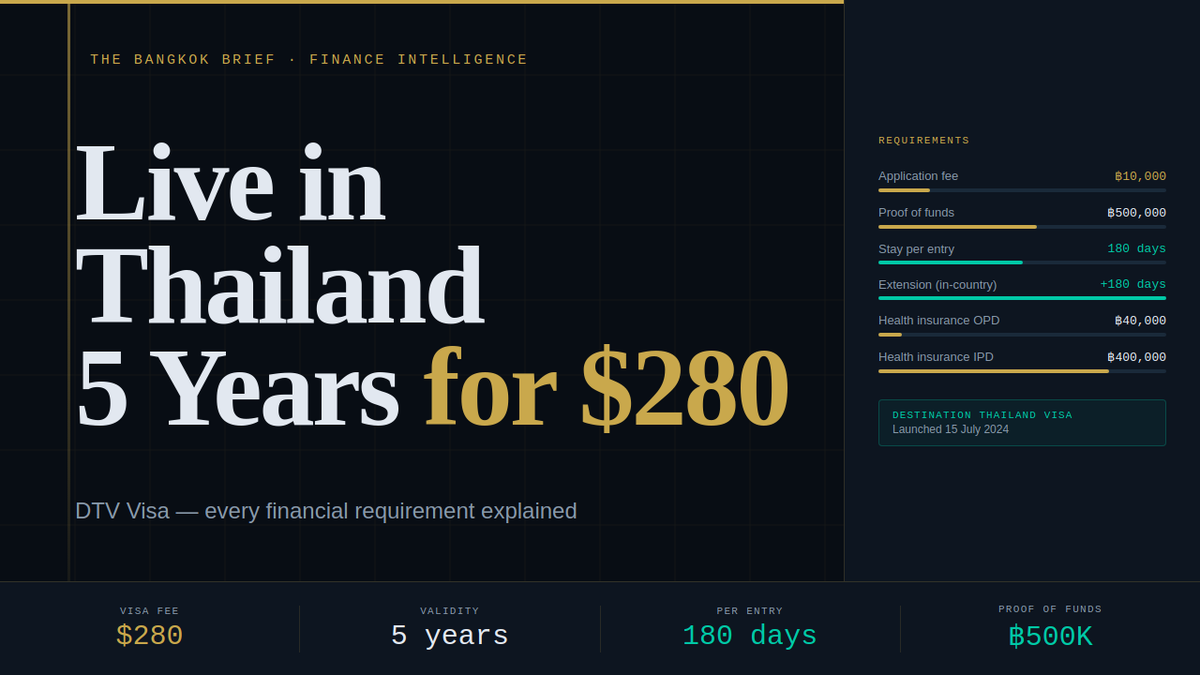
Thailand's Destination Thailand Visa (DTV) costs ฿10,000 — roughly $280 USD — and gives remote workers, digital nomads, and freelancers a government-issued long-stay option valid for five full years. Launched on 15 July 2024 under Thailand's Soft Power initiative, it is not a tourist visa workaround. It is a purpose-built visa for location-independent workers, and its cost-to-benefit ratio makes it the most compelling long-stay visa in Southeast Asia for people earning income abroad.
What Is the DTV and Why It Matters
The Destination Thailand Visa is a single-entry, multi-stay visa that sits under Thailand's broader "Soft Power" visa category — a cluster of visa types designed to attract creative professionals, remote workers, and high-value international residents. Unlike the Thailand Elite Visa (a paid membership scheme) or the LTR Visa (which requires meeting strict income and asset thresholds), the DTV is accessible to the typical digital nomad with a standard remote income and a healthy savings account.
Each DTV entry grants a 180-day permitted stay. Within that period, the holder can apply for a single in-country extension of another 180 days — meaning a single entry can legally cover a full calendar year without leaving Thailand. After using that entry, the holder exits, re-enters on the same visa, and the 180-day clock resets. This continues for the visa's five-year validity.
Full Financial Requirements Breakdown
There are three financial components to the DTV application. Understanding each one separately is important because they serve different purposes.
1. Visa Application Fee: ฿10,000 (~$280)
This is the one-time government fee paid at the time of application. It is non-refundable, paid to the Thai embassy or consulate where you apply, and covers the full five-year visa validity. There is no annual renewal fee. At current exchange rates (approximately ฿36–37 per USD), this translates to roughly $270–$280 depending on when you apply.
2. Proof of Funds: ฿500,000 (~$13,600–$14,000)
Applicants must demonstrate they hold at least ฿500,000 in accessible funds. This is a bank balance requirement, not a transfer requirement — you show the money exists; you do not send it to Thailand. Acceptable documentation typically includes:
- Bank statements from the past 3–6 months showing the balance
- The balance must be maintained, not just briefly deposited — immigration officers look for stability
- Foreign currency accounts are acceptable, converted at current rates
- Cryptocurrency holdings are generally not accepted as proof of funds
At a USD/THB rate of ฿36.5, ฿500,000 equals approximately $13,699 USD. At ฿37, it equals approximately $13,514. Budget for $14,000 to be safe given currency fluctuation.
3. Mandatory Health Insurance
Health insurance is compulsory for DTV holders and must meet minimum coverage thresholds set by Thai immigration:
| Coverage Type | Minimum (THB) | Approximate USD |
|---|---|---|
| Outpatient (OPD) | ฿40,000 | ~$1,100 |
| Inpatient (IPD) | ฿400,000 | ~$11,000 |
These are annual minimums per policy period. Most international health insurance plans (e.g., SafetyWing, Cigna Global, AXA) exceed these thresholds comfortably. Budget between $500–$2,000 per year for a qualifying policy depending on your age, nationality, and coverage level. This is the DTV's most significant ongoing cost.
DTV vs. Alternative Long-Stay Options: Cost Comparison
| Visa Type | Upfront Cost | Stay Per Entry | Duration | Income/Asset Requirements |
|---|---|---|---|---|
| Thailand DTV | ~$280 | 180 days (+180 extension) | 5 years | ฿500,000 in funds + insurance |
| Thailand Elite Visa (Basic) | ~$14,000 | 365 days | 5–20 years | None beyond fee |
| Thailand LTR Visa | ~$200 (fee) | 365 days | 10 years | $80,000/yr income or $250,000 assets |
| Bali Digital Nomad Visa (Indonesia) | ~$1,500–$2,000 | 60 days renewable | Up to 1 year | $2,000/month income proof |
| Thailand Tourist Visa + Border Runs | ~$40–$80 per run | 30–60 days | Indefinite but precarious | None formally |
The DTV's competitive position is clear: it offers near-Elite-level long-stay access at a fraction of the cost, with more achievable entry requirements than the LTR Visa.
Stay Structure: How the 180-Day System Works in Practice
Understanding the stay mechanics is essential before applying. The DTV is not a permanent residency visa — it does not automatically give you 365 days per year in Thailand. Here is exactly how the calendar works:
- Enter Thailand on DTV: Stamped for 180 days from date of entry.
- Apply for in-country extension before Day 180: Submit at a local Immigration office with required documents. Extension grants another 180 days from the date of the original stamp expiry — not from the extension application date.
- Exit Thailand before Day 360: The entry is now "used." The DTV remains valid.
- Re-enter on the same DTV: New 180-day period begins. Repeat for up to 5 years from visa issue date.
If you do not apply for the extension, you must exit by Day 180. Overstaying carries fines of ฿500 per day, capped at ฿20,000, plus potential bans from re-entry — do not overstay.
Worked Example: Total First-Year Cost for a DTV Holder
Let's say you're a UK-based freelance developer earning £4,000/month (~฿185,000) planning to spend 10 months in Thailand in Year 1.
| Cost Item | Amount (THB) | Amount (USD approx.) | Notes |
|---|---|---|---|
| DTV application fee | ฿10,000 | ~$280 | One-time, 5-year validity |
| Health insurance (annual) | ฿25,000–฿55,000 | ~$700–$1,500 | Varies by provider and age |
| In-country extension fee | ฿1,900 | ~$52 | Per extension at Immigration |
| Proof of funds (held, not spent) | ฿500,000 | ~$13,700 | Stays in your account |
| Total cash outlay Year 1 | ฿36,900–฿66,900 | ~$1,032–$1,832 | Excluding living costs |
From Year 2 onward, the DTV fee disappears. Annual cash cost drops to health insurance + any extension fees — potentially under $800/year for the remaining four years of validity. Over the full five years, total visa-related overhead averages well under $500 per year.
Who the DTV Is and Isn't For
Strong candidates:
- Remote workers employed by companies outside Thailand spending 4+ months per year in the country
- Freelancers and contractors with foreign-source income
- Digital nomads who want a stable Southeast Asia base without committing to a single country full-time
- Content creators, developers, designers, consultants with portable income
Poor candidates:
- Anyone who wants to work for a Thai company or clients — the DTV does not grant a Thai work permit
- Retirees (the Non-Immigrant O-A Retirement Visa is better suited)
- People who cannot demonstrate ฿500,000 in stable, accessible funds
- Those wanting 365-day unbroken stays without any exit (consider Elite or LTR instead)
Thailand's Economic Context in 2025
Thailand's GDP growth reached 2.54% in 2024, up from 2.02% in 2023. Inflation dropped sharply to 1.37% in 2024 from a peak of 8.48% in 2023 — meaning the cost of living in Thailand has stabilised significantly. For digital nomads earning in USD, GBP, or EUR, baht-denominated living costs remain highly favourable. The DTV is arriving at precisely the moment Thailand's macro environment makes it most attractive as a base.
Frequently Asked Questions
Can I work while on a DTV?
You can continue your existing remote work — employed or freelance — for clients and employers outside Thailand. The DTV does not grant permission to work for Thai entities or physically perform work services within Thailand for Thai clients. If you're a developer, writer, or consultant working with non-Thai clients remotely, you are in the intended use case. Always consult a Thai immigration lawyer if your situation involves Thai-source income.
Does the ฿500,000 need to be in a Thai bank account?
No. The funds can be in a foreign bank account. You submit bank statements showing the balance. Some consulates may prefer statements from the past 3–6 months showing consistent balances rather than a single large recent deposit, so avoid moving money in just before your application.
What happens to the DTV and Thai tax — do I owe Thai income tax?
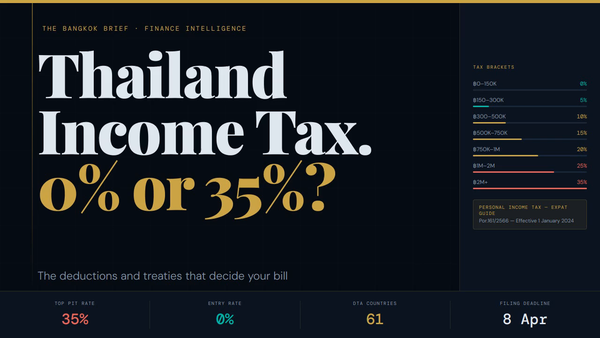
Holding a DTV does not automatically make you a Thai tax resident. Thai tax residency is triggered by spending 180 days or more in Thailand in a calendar year. If you trigger tax residency, a 2024 Revenue Department rule change means foreign-sourced income remitted to Thailand in the same tax year it is earned may be assessable. This is a rapidly evolving area — monitor updates from the Thai Revenue Department and consult a tax professional if you plan to exceed 180 days annually.
Where do I apply for the DTV?
Applications are submitted at a Thai embassy or consulate in your country of residence. You cannot apply for the DTV on arrival or through the Thai e-Visa system in all jurisdictions — check with your nearest Thai diplomatic mission for current processing options. Processing times vary from 3 to 15 business days.
Can I bring dependants on the DTV?
The DTV itself does not include automatic dependant provisions in the way the LTR Visa does. Spouses and children would need to obtain their own visas. Consult the Thai embassy in your jurisdiction for the latest guidance, as policy details can vary by consulate.
Action Steps
- Verify your funds position: Confirm you can show ฿500,000 (~$14,000) in a stable bank account for at least 3–6 months before applying.
- Get qualifying health insurance: Source a policy meeting the ฿40,000 OPD / ฿400,000 IPD minimums before your application — you'll need the policy document as part of your submission.
- Book a consulate appointment: Contact the Thai embassy or consulate in your country of residence. Confirm current document requirements, as individual consulates can apply slightly different checklists.
- Prepare your remote work documentation: Employment contract, freelance contracts, or business registration showing your income source is outside Thailand.
- Track your 180-day clock from day one: Set a calendar reminder 30 days before your permitted stay expires — either to apply for the in-country extension or to plan your exit.
- Consult a Thai tax professional: If you plan to spend 180+ days in Thailand, get clarity on your tax position under the current remittance rules before you remit funds.