Thailand LTR Visa: 10-Year Stay & Foreign Income Tax Exempt
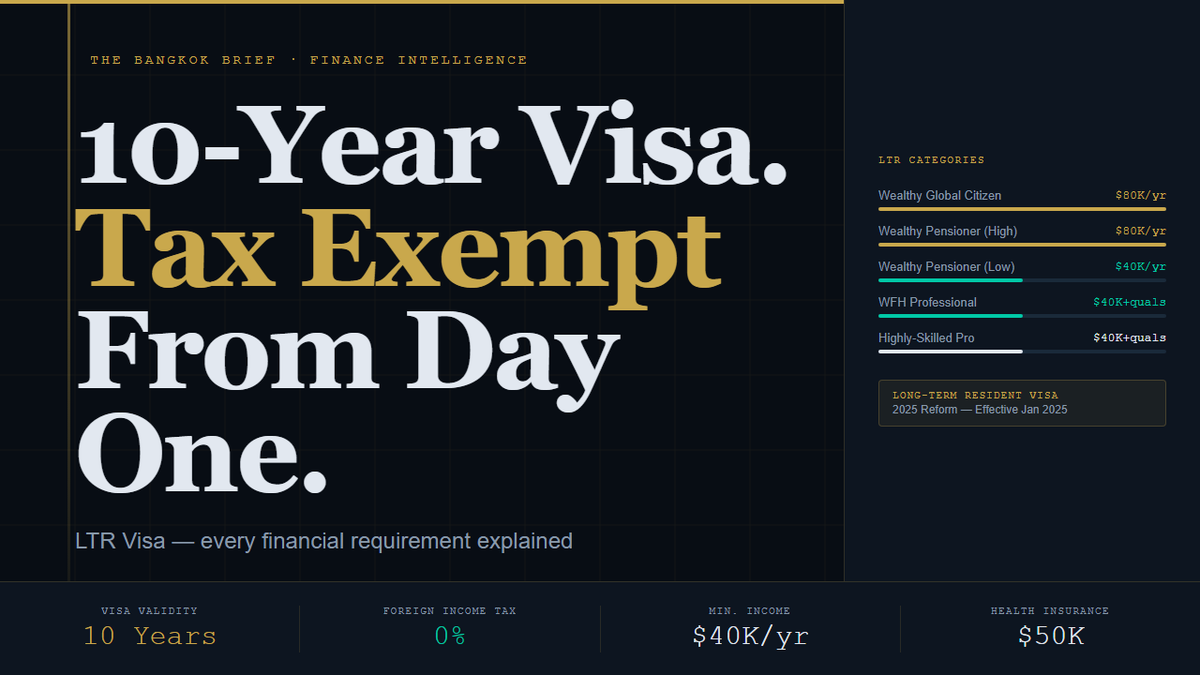
https://www.youtube.com/watch?v=0lUx7AuqJ7I
Thailand's Long-Term Resident (LTR) visa is the only long-stay visa in Southeast Asia that combines a 10-year multiple-entry permit, zero 90-day reporting obligations, and a legally codified exemption from Thai personal income tax on foreign-sourced income — all in a single instrument. As of 2025, the income thresholds have been lowered, making it accessible to more expats than at any point since the programme launched in 2022. If you earn foreign income and plan to spend significant time in Thailand, understanding the LTR is not optional: the 2024 Por.161 tax ruling made it the difference between paying up to 35% Thai income tax and paying nothing.
Why the LTR Visa Matters More in 2025 Than It Did in 2022
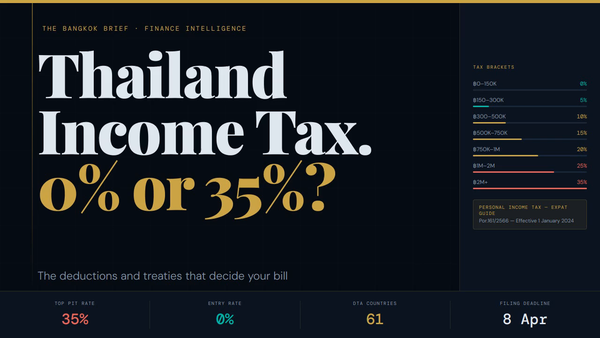
When the LTR visa launched in September 2022, it was marketed primarily as a lifestyle product — a premium long-stay option for high-net-worth individuals. What changed the calculus entirely was the Thai Revenue Department's Por.161 ruling in late 2023, effective 1 January 2024. Under Por.161, any foreign income remitted to Thailand by a Thai tax resident (anyone spending 180+ days per year in Thailand) is now assessable for Thai personal income tax, regardless of when it was earned.
Thai personal income tax brackets run as follows:
| Taxable Income (฿) | Tax Rate |
|---|---|
| 0 – 150,000 | 0% |
| 150,001 – 300,000 | 5% |
| 300,001 – 500,000 | 10% |
| 500,001 – 750,000 | 15% |
| 750,001 – 1,000,000 | 20% |
| 1,000,001 – 2,000,000 | 25% |
| 2,000,001 – 5,000,000 | 30% |
| 5,000,001+ | 35% |
The LTR visa grants a full exemption from Thai personal income tax on foreign-sourced income from the date of visa issuance, by royal decree. This exemption applies for the full 10-year validity of the visa. No other long-stay Thai visa — not the DTV, not the Thailand Elite, not the Non-Immigrant O-A retirement visa — provides this protection.
The 4 LTR Visa Categories: Requirements at a Glance
The LTR visa is split into four distinct categories. Each has its own financial and eligibility thresholds. All four share a universal health insurance requirement of at least $50,000 (฿1.8M+) in coverage.
| Category | Age Requirement | Income Threshold | Asset / Investment Requirement | Other |
|---|---|---|---|---|
| Wealthy Global Citizen | None | $80,000/year | $1,000,000 in assets + $500,000 in Thai investment (govt bonds, property, or FDI) | Health insurance $50K min |
| Wealthy Pensioner | 50+ | $80,000/year OR $40,000/year | If $40K income: $250,000 in Thai investment required | Health insurance $50K min |
| Work-from-Thailand Professional | None | $80,000/year OR $40,000/year | If $40K income: Master's degree, patent, or Series A funding required | Employer must have 3+ years of operation; health insurance $50K min |
| Highly Skilled Professional | None | $80,000/year (averaged over 2 yrs) | Must work in targeted S-curve industry (biotech, aerospace, digital, etc.) | Health insurance $50K min; work permit included |
Category Deep-Dives
Wealthy Global Citizen
This category targets ultra-high-net-worth individuals. The $1,000,000 asset requirement is assessed via bank statements, investment portfolios, or property valuations. The $500,000 Thai investment can be deployed across Thai government bonds, BOI-promoted entities, or Thai real estate (condominiums). Income of $80,000/year must be demonstrated via tax returns, employment contracts, or audited business accounts. This is the most demanding category but also the most straightforwardly structured — if you have the assets, the application is largely documentary.
Wealthy Pensioner
The most popular category among retirees. The dual-path structure is its defining feature: applicants earning $80,000+/year can qualify on income alone, while those earning as little as $40,000/year can qualify by placing $250,000 into Thai government bonds, Thai property, or Thai equity funds. At the 2025 thresholds, a retiree with a $3,333/month pension and a modest investment portfolio can legitimately qualify. The age floor is 50 — no upper limit applies.
Work-from-Thailand Professional
Designed for remote employees of foreign companies. The employer must have been operating for at least 3 years. Income of $80,000/year clears the standard bar; $40,000/year qualifies if the applicant holds a Master's degree, an active patent, or Series A+ startup funding. This category does not include a Thai work permit — the applicant works for a foreign employer and cannot take Thai employment. Health insurance at $50,000 coverage is mandatory.
Highly Skilled Professional
This is the only LTR category that includes a Thai work permit. It targets workers in Thailand's designated S-curve industries: digital technology, aerospace, biofuels, automation and robotics, smart electronics, medical devices, biotechnology, and food processing. Income of $80,000/year averaged over the prior two years is required. Applications in this category are coordinated directly with the relevant Thai government agency for the applicant's sector.
LTR vs. Other Long-Stay Options: The Full Comparison
| Feature | LTR Visa | DTV (Digital Nomad) | Thailand Elite | Non-Imm O-A (Retirement) |
|---|---|---|---|---|
| Maximum validity | 10 years | 5 years | 5–20 years | 1 year (renewable) |
| Entry per stamp | Multiple (unlimited) | 180 days per entry | Multiple | Single (re-entry permit req.) |
| Immigration reporting | Annual only | Every 90 days | Every 90 days | Every 90 days |
| Re-entry permit | Not required | Not required | Not required | Required (฿3,800/trip) |
| Foreign income tax exemption | Yes — by royal decree | No | No | No |
| Government fee (approx.) | ฿50,000 (~$1,400) | ฿10,000 (~$280) | ฿500,000–฿2M+ | ฿1,900/year |
| Work permit available | Highly Skilled only | No | No | No |
The Tax Exemption: How It Works in Practice
The LTR tax exemption is not a grey area or a planning strategy — it is written into the Thai royal decree that established the programme. LTR visa holders are exempt from Thai personal income tax on all income sourced from outside Thailand. This includes:
- Salary or dividends from a foreign employer or foreign company
- Investment returns from foreign-held portfolios
- Rental income from properties outside Thailand
- Pension payments from foreign pension schemes
- Capital gains realised on overseas assets
Income earned within Thailand — from Thai employment, Thai business operations, or Thai-sourced investments — is not exempt and remains assessable under standard Thai PIT rules. LTR holders employed in Thailand under the Highly Skilled Professional category pay standard Thai income tax on their Thai employment income.
Worked Example: What the Tax Exemption Saves You
Let's say you are a 52-year-old British retiree who qualifies under the Wealthy Pensioner category. You receive a pension of £36,000/year (~$45,000/year, ~฿1,620,000/year at ฿36/$1) and remit the full amount to your Thai bank account to cover living costs.
Without the LTR visa (standard tax resident under Por.161):
- Assessable income: ฿1,620,000
- Less personal allowance (฿60,000) and 50% expense deduction capped at ฿100,000: net taxable ~฿1,460,000
- Tax on ฿1,460,000 using progressive brackets: approximately ฿222,500/year (~$6,180)
With the LTR visa:
- Tax on foreign pension income: ฿0
- Annual saving: ~฿222,500 (~$6,180)
The LTR visa application fee is approximately ฿50,000 (~$1,400). At this level of savings, the visa pays for itself in under 3 months. Over 10 years, the total tax saving on this income alone would be approximately ฿2,225,000 (~$61,800).
For higher earners — say, a Work-from-Thailand Pro remitting $120,000/year — the savings are dramatically larger. Thai PIT on ฿4,320,000 of assessable income (after deductions) would approach ฿900,000/year (~$25,000). The LTR visa eliminates this entirely.
Application Process: BOI One Stop Service Centre
LTR visa applications are processed exclusively through the Board of Investment (BOI) One Stop Service Centre. Locations include:
- Bangkok — Chamchuri Square (primary processing centre)
- Chiang Mai — Promenada Resort Mall
- Phuket — BOI Regional Office
- Online application portal: ltr.boi.go.th
The standard processing timeline is 20 working days from submission of a complete application. The BOI reviews eligibility before the application is forwarded to Immigration, so approval at the BOI stage is effectively an approval of the visa. Incomplete applications — particularly those missing health insurance documentation or income evidence — are the primary cause of delays.
Core Documents Required Across All Categories
- Valid passport (minimum 12 months remaining validity)
- Health insurance certificate showing $50,000+ coverage (must be from an approved Thai or international insurer)
- Proof of income: last 2 years of tax returns, bank statements, or audited accounts
- Proof of assets (category-dependent)
- Criminal background check (apostilled, from country of residence)
- Medical certificate (no prohibitive communicable diseases)
- Recent passport-size photographs
Frequently Asked Questions
Can I qualify for the LTR visa on investment income alone — no salary?
Yes. The income requirement can be met through dividends, rental income, pension payments, or investment distributions — any documented, recurring foreign income. It does not need to come from employment. Bank statements and investment account statements showing consistent inflows over the prior 12–24 months are the standard evidence.
Does the $40,000/year income threshold apply to every category?
No. The $40,000/year lower threshold is available only in the Wealthy Pensioner and Work-from-Thailand Professional categories, and only when paired with either a $250,000 Thai investment (Pensioner) or a qualifying credential such as a Master's degree or patent (WFT Pro). The Wealthy Global Citizen and Highly Skilled Professional categories require $80,000/year with no reduced alternative.
If I hold an LTR visa, do I still need to file a Thai tax return?
LTR holders with no Thai-sourced income are generally not required to file a Thai personal income tax return, as the foreign income exemption means there is no assessable income. However, if you receive any Thai-sourced income — including interest on Thai bank deposits above certain thresholds — you may still have a filing obligation. Consulting a Thai tax advisor in your first year is strongly recommended.
Can my spouse and dependants be included on my LTR visa?
Yes. Spouses and children (under 20) can be included as dependants on the primary applicant's LTR visa. Dependants receive the same 10-year multiple-entry status and annual reporting requirement, but the tax exemption applies only to the primary visa holder's foreign income — not to income earned independently by the spouse.
What happens if my income drops below the threshold after the visa is issued?
The LTR visa is issued for 10 years and is not subject to annual income verification in the same way as a retirement visa. However, the BOI requires an annual report confirming continued eligibility. If your circumstances change significantly — particularly if you no longer hold qualifying health insurance — you should seek advice from the BOI directly. There is no automatic revocation for short-term income fluctuations, but sustained non-compliance with the original qualifying criteria could affect renewal.
Action Steps
- Identify your category. Use the table above to determine which of the 4 LTR categories fits your income, assets, age, and employment situation. Most retirees will target Wealthy Pensioner; most remote workers will target Work-from-Thailand Professional.
- Audit your income documentation. Gather 2 years of tax returns, bank statements, and investment account records. The BOI wants to see consistent, verifiable foreign income — not a single large deposit.
- Secure qualifying health insurance. Source a policy with at least $50,000 coverage before applying. Confirm the insurer is accepted by the BOI — not all international policies qualify. Budget policies from Thai insurers (e.g., AXA Thailand, Pacific Cross) typically meet the threshold for under $500/year.
- Obtain your criminal background check early. This document requires apostilling from your home country and is the most time-consuming element of the application. Start this process 6–8 weeks before you intend to submit.
- Submit via BOI One Stop Service Centre. Apply online at ltr.boi.go.th or in person at one of the four regional centres. Track your application through the BOI portal — approval notifications are issued by email.