Moving Money to Thailand: Wise Fees & FX Costs Explained
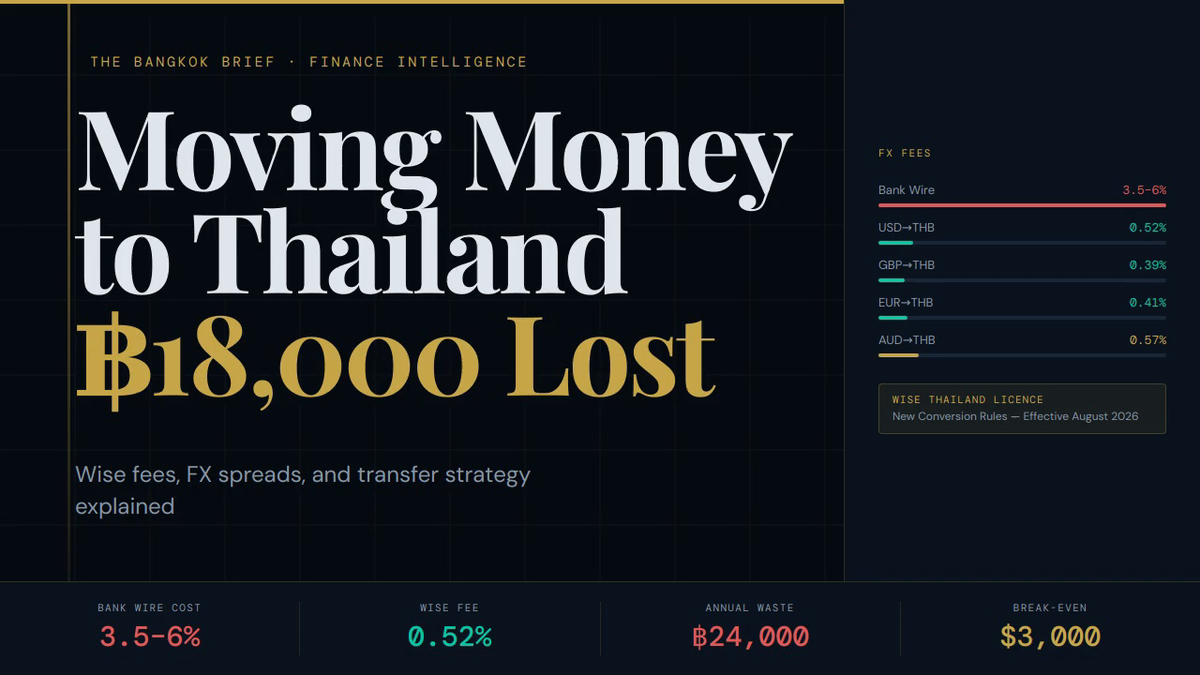
If you are moving money to Thailand through a traditional bank wire in 2026, you are almost certainly losing between 3.5% and 6% of every transfer — not in declared fees, but in exchange rate spread. On a ฿600,000/year remittance budget, that is ฿12,000–฿24,000 in pure, avoidable cost that never appears on any statement. This guide explains exactly where that money goes, how Wise compares corridor-by-corridor, what Wise's new Thai financial services licence changes about the mechanics of your transfer, and how Thai tax residency rules interact with the timing and structure of every baht you bring into the country.
Why Your Bank's Exchange Rate Is the Real Fee
Banks do not make money on international transfers through wire fees alone. The larger and less visible profit comes from the exchange rate spread — the gap between the mid-market rate (the real interbank rate you can check on Google or XE.com) and the rate your bank actually applies to your transaction. A spread of ฿1.50–฿2.50 per US dollar is typical for retail bank wires in 2026.
The arithmetic is straightforward. If the mid-market USD/THB rate is 35.50 and your bank applies 34.00, you lose ฿1.50 per dollar converted. On a $1,400 transfer (roughly ฿50,000 at mid-market), that is ฿2,100 lost in a single transaction. Over 12 months, that is ฿25,200 — handed to a bank that provided zero currency risk management, zero added service, and zero disclosure of the margin it was extracting.
Wise vs. Traditional SWIFT Wire: The 2026 Cost Comparison
Wise operates on a fundamentally different model. It moves money between local accounts in each country — using its own pooled balance infrastructure — rather than routing through the SWIFT correspondent banking network. The result is a transparent, small percentage fee applied to the mid-market rate with no spread markup.
| Transfer Method | Cost on $2,000 USD→THB | Effective Fee % | Typical Speed |
|---|---|---|---|
| Traditional bank SWIFT wire | $70–$120 | 3.5–6.0% | 2–5 business days |
| Wise | $12–$15 | 0.52–0.66% | Seconds to 1 business day |
| Instarem | $14–$20 | 0.6–0.8% | 1–2 business days |
| Western Union (online) | $20–$40 | 1.0–2.0% | Minutes to 1 day |
The gap between Wise and a traditional bank wire on a single $2,000 transfer is $55–$105. That may sound manageable in isolation. But expats remitting ฿600,000/year (roughly $16,700 at 2026 rates) are making this transfer repeatedly — and the annual waste compounds to ฿12,000–฿24,000 depending on which bank and which months they transfer in.
Wise FX Fees by Corridor (2026)
Wise fees are not uniform across all currency pairs. The fee percentage varies by corridor based on liquidity, local banking infrastructure costs, and regulatory overhead. The following are the verified 2026 rates for the most common expat-to-Thailand corridors:
| Currency Corridor | Wise Fee (%) | Notes |
|---|---|---|
| USD → THB | 0.52% | Most common corridor for US/Americas-based expats |
| GBP → THB | 0.39% | Lowest fee corridor — favourable for UK expats |
| EUR → THB | 0.41% | Strong liquidity; competitive rate |
| AUD → THB | 0.66% | Highest among major corridors; still far below SWIFT |
| CAD → THB | 0.59% | Mid-range; check live rate before large transfers |
All Wise fees are applied to the mid-market rate with no additional spread. The fee you see at quote stage is the fee you pay — there are no hidden correspondent bank deductions on the Thai end.
Wise's Thai Financial Services Licence: What Changes in August 2026
In August 2026, Wise received a formal Thai financial services licence, formalising its operating status in the country. For most users, the user experience remains largely the same. However, there are two mechanical changes worth understanding before your next transfer:
- Forced conversion rule: Under the new licence framework, certain inbound transfers above a regulatory threshold are subject to mandatory conversion to THB on arrival at the Thai receiving bank. You cannot instruct the receiving institution to hold USD or GBP balances pending a more favourable rate. The conversion happens at the prevailing interbank rate at the time of settlement.
- Improved regulatory standing: The licence strengthens Wise's position as a compliant remittance channel under Thai law — relevant context if you are documenting foreign-source income for Thai tax purposes, since bank confirmation of the transfer channel and amount may be requested by the Thai Revenue Department.
For most routine transfers under ฿500,000, the forced conversion rule has minimal practical impact since most users are converting anyway. For larger or strategically timed transfers, understanding the settlement window matters.
THB/USD Exchange Rate Volatility: Why Timing Matters as Much as Fees
The exchange rate environment for THB has been notably volatile across 2023–2026:
| Period | USD/THB Rate | Implication for ฿50,000/month remitters |
|---|---|---|
| 2023 average | 35.1 | Need ~$1,424/month |
| 2024 average | 34.8 | Need ~$1,437/month |
| Early 2025 | 36.2 | Need ~$1,381/month — baht weakening helps remitters |
| Early 2026 | ~35.5 (indicative) | Mid-range — monitor before large single transfers |
The swing between 34.8 and 36.2 represents a 4% difference in purchasing power for a fixed-dollar income. For expats converting $2,000/month, that is roughly ฿2,800/month — or ฿33,600/year — solely from rate timing, independent of fees. Splitting large transfers into smaller tranches across a month (rate averaging) is a practical strategy for remitters who cannot time the market but want to reduce exposure to single-day rate swings.
Transfer Strategy by Amount: A Practical Decision Framework
Not every transfer warrants the same approach. The following framework reflects 2026 conditions:
- Under $3,000 (≈฿105,000): Wise is the clear default. The fee is transparent, the rate is mid-market, and the speed is unmatched. No comparison needed.
- $3,000–$10,000 (≈฿105,000–฿350,000): Wise remains the likely winner, but run a live comparison against Instarem on transfer day. The corridor and exact daily fee can vary slightly.
- Over $10,000 (≈฿350,000+): At this size, even a 0.1% difference represents ฿350+. Check Wise, Instarem, and your bank's international business desk (some banks offer preferential rates for large transfers to existing customers). The additional 10 minutes of comparison at this scale is always worth it.
Worked Example: What Does a ฿600,000/Year Remittance Actually Cost?
Scenario: UK expat, remitting £14,000/year (≈฿600,000) in monthly instalments of £1,167
Via traditional UK high-street bank SWIFT wire:
- Spread on GBP→THB: approximately 2.5–4% above mid-market
- Fixed wire fee: £15–£25 per transaction
- Cost per transfer: £29–£71 (fee + spread on £1,167)
- Annual cost: £348–£852 (≈฿16,000–฿39,000)
Via Wise (GBP→THB at 0.39%):
- Fee per £1,167 transfer: £4.55
- Annual fee total: £54.60 (≈฿2,500)
- No spread — mid-market rate applied
Annual saving by switching to Wise: £293–£797 (≈฿13,500–฿36,500)
This is not a marginal optimisation. For a retiree or remote worker on a fixed income remitting a consistent living budget, switching transfer provider is one of the highest-return single actions available — requiring approximately 20 minutes of account setup time.
Thai Tax Residency and Remittance Timing: What Every Expat Must Understand
If you have spent 180 or more days in Thailand in a calendar year, you are a Thai tax resident under Section 41 of the Thai Revenue Code. This status does not depend on your visa type — it is purely a day-count threshold that applies to tourist visa holders, retirement visa holders, LTR visa holders, and digital nomads equally.
Under Paw 161/2566 (effective 1 January 2024), the Thai Revenue Department eliminated the one-year deferral rule. Previously, foreign-source income earned in year one could be remitted in year two tax-free. That loophole is closed. Any foreign-source income remitted to Thailand in the same calendar year it was earned is now assessable for Thai personal income tax if you are a tax resident.
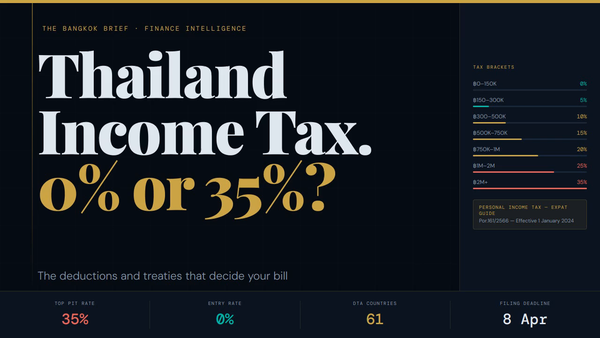
| Thai Personal Income Tax Bracket | Assessable Income (฿/year) | Rate |
|---|---|---|
| Exempt | Up to ฿150,000 | 0% |
| Band 1 | ฿150,001–฿300,000 | 5% |
| Band 2 | ฿300,001–฿500,000 | 10% |
| Band 3 | ฿500,001–฿750,000 | 15% |
| Band 4 | ฿750,001–฿1,000,000 | 20% |
| Band 5 | ฿1,000,001–฿2,000,000 | 25% |
| Band 6 | ฿2,000,001–฿5,000,000 | 30% |
| Band 7 | Over ฿5,000,000 | 35% |
The practical implication: remitting pre-2024 savings (capital that was earned and held before 1 January 2024) is currently treated as non-assessable by the Thai Revenue Department, since it falls outside the scope of Paw 161/2566. Remitting current-year earned income — salary, freelance revenue, dividends, rental income — into Thailand as a tax resident triggers assessment at the brackets above, after applicable deductions and allowances.
This makes the source and timing of what you remit a structural tax decision, not just a cashflow one. Before sending a large transfer, identify whether you are moving savings or current income — and consider the tax consequence before executing.
Frequently Asked Questions
Does Wise report my transfers to the Thai Revenue Department?
Wise, as a licensed financial services provider in Thailand from August 2026, is subject to Thai AML and reporting obligations for transactions above regulatory thresholds. For CRS purposes, Wise reports account information to the tax authority of the account holder's country of residence — not automatically to the Thai Revenue Department. However, the Thai Revenue Department can and does request transfer records from Thai banks upon audit. Maintaining your own records of what you remit and its source is strongly advised.
Is my Wise transfer treated as "remitted income" for Thai tax purposes?
Yes. Any funds transferred into a Thai bank account — regardless of the transfer provider used — constitute a remittance for Thai tax purposes. The method of transfer (Wise, SWIFT, cash deposit) does not change the tax characterisation of the money. What matters is the source of the funds and the year they were earned.
Can I hold foreign currency in Wise and convert to THB only when the rate is favourable?
Wise allows you to hold balances in multiple currencies in your Wise account. You can convert to THB manually at a time of your choosing and then send to your Thai bank. This gives you de facto rate timing control, which your traditional bank does not offer for routine retail wires. Note the forced-conversion rule applies at the Thai bank end upon receipt — not within the Wise platform itself.
What documentation should I keep for large transfers?
For every transfer you make as a Thai tax resident, retain: the Wise (or bank) transfer confirmation with date, amount in source currency, amount in THB, and exchange rate applied; a note of the source of the funds (payslip, invoice, savings account statement); and your Thai bank's incoming transfer confirmation (the SWIFT advice or inward remittance document your Thai bank issues). This documentation package is what a Thai tax adviser or the Revenue Department will ask for if your returns are reviewed.
Does the Long-Term Resident (LTR) visa exempt me from Thai tax on remittances?
The LTR visa (Wealthy Pensioner, Wealthy Global Citizen, Work-from-Thailand Professional categories) does carry specific tax incentives for certain income types, including an exemption from Thai tax on foreign-sourced income remitted to Thailand for qualifying LTR holders. However, the conditions are specific and the exemption is not automatic — you must have applied for and received the tax benefit under the LTR scheme from the Board of Investment. If you hold an LTR visa but have not confirmed your tax benefit status with a Thai tax adviser, do not assume the exemption applies.
Action Steps
- Check your last three bank wire confirmations and calculate the exchange rate you actually received versus the mid-market rate on the same day. Quantify your annual spread cost in baht.
- Open a Wise account and verify your identity (typically takes 24–48 hours). Do not wait until your next transfer deadline.
- Identify the source of funds for every transfer you plan to make this calendar year — savings (pre-2024) or current-year income. Record this in a simple spreadsheet before the transfer is made, not after.
- For transfers over $10,000, run a three-way live comparison (Wise, Instarem, your bank's international desk) on transfer day before committing.
- If you have spent or expect to spend 180+ days in Thailand this calendar year, book a consultation with a Thai tax adviser before 31 December to assess your filing obligation and remittance structure. The filing deadline is 31 March of the following year.